![iblum_Icon_RGB.png]](https://help.iblum.co/hs-fs/hubfs/iblum_Icon_RGB.png?height=40&name=iblum_Icon_RGB.png)
An Early Learning Activity is a purposeful, play-based experience designed to support a child’s development through hands-on exploration.
Goal:
- Develop well-documented, easily replicable activities that align with the principles of the educational program.
- Design activities that support both new and experienced educators in implementing a play-based, Reggio-inspired approach.
Why:
We believe in the power of educators to shape meaningful learning experiences - and we want to fuel that power with confidence and creativity. Many educators are new to designing open-ended, play-based activities rooted in the Reggio Emilia philosophy. They often come from more structured, teacher-led approaches and may feel unsure about where to begin.
We’re here to support them, by offering rich, inspiring examples that spark imagination and show what’s possible. These activities, informed by the insights of iBlum, aren’t just ideas - they’re tools to deepen understanding, build confidence, and connect theory to practice.
By providing these resources, we are helping educators feel successful and empowered as they cross into new territory. And in doing so, we ensure that children receive the best possible learning experiences - ones that are joyful, meaningful, and developmentally rich.
Let’s inspire a new generation of educators to lead with play, curiosity, and purpose.
How to Create and Share Early Learning Activities:
A. Originality and Sourcing
- Activities must be original and suitable for publication. Do not copy directly from other resources.
- Always write the activity in your own words. If inspiration is drawn from an external source, provide proper credit or reference.
B. Required Information for Each Activity
1. Activity Name
Provide a clear and descriptive title that reflects the key focus in the activity.
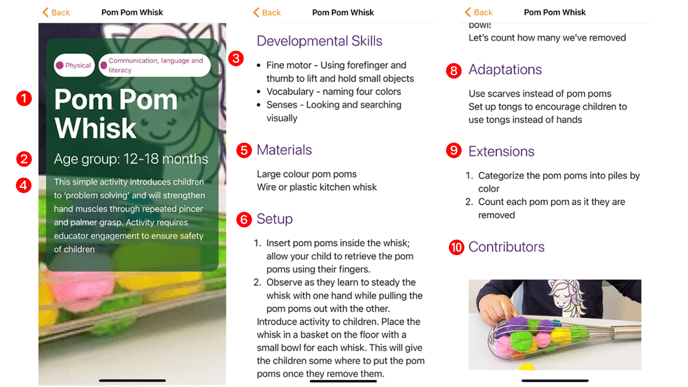
Example: Pom Pom Whisk
2. Age Group
Specify the target age range for the activity, ensuring developmental suitability.
Example: 12–18 months
3. Learning Area
Indicate the primary developmental or curriculum area this activity supports (e.g., sensory, cognitive, fine motor, language, etc.).
Example: Sensory
4. Introduction Statement
Provide an overview of the activity, including its purpose, educational value, and any specific skills it is intended to develop.
Example: This simple activity introduces children to ‘problem solving’ and will strengthen hand muscles through repeated pincer and palmer grasp. Activity requires educator engagement to ensure safety of children
5. Materials
List all materials required to conduct the activity, including quantities where applicable. Use specific descriptors (e.g., size, color, type) to support clarity.
Example: Large, colored pom poms, Wire or plastic kitchen whisk
6. Setup
Provide a step-by-step guide for preparing and presenting the activity. This should include preparation of materials, arrangement of the learning space, and strategies for introducing the task to the children.
Example: Insert pom poms inside the whisk; allow your child to retrieve the pom poms using their fingers. Observe as they learn to steady the whisk with one hand while pulling the pom poms out with the other.
Introduce activity to children. Place the whisk in a basket on the floor with a small bowl for each whisk. This will give the children some where to put the pom poms once they remove them.
7. Conversation
Offer examples of intentional language and open-ended questions educators can use to scaffold learning, promote vocabulary development, and encourage observation and reflection.
Example:
I see you have the red pom pom.
It feels very soft (gently guide the pom pom on the child’s hand).
Can you remove all the orange pom poms?
Now try putting them all back inside the whisk.
Wow! Look how many you have in your bowl!
Let’s count how many we’ve removed.
8. Adaptation
Describe modifications or alternative approaches to support the diverse needs and abilities of all children, ensuring the activity remains inclusive and accessible.
Example:
Use scarves instead of pom poms
Set up tongs to encourage children to use tongs instead of hands
9. Extension
Suggest ways to extend or enrich the activity for children who are ready for additional challenges, or to deepen learning through variation.
Example:
Categorize the pom poms into piles by color.
Count each pom pom as it they are removed.
10. Contributors
Name of the educator(s) or center who developed or submitted the activity.
11. Photograph
Include a clear photograph(s) of the activity setup.
Example of Early Learning Activity:
C. Document and Photograph Submission Guidelines
- Submit the completed form along with the accompanying photographs to your manager.
- Ensure that all photographs are clear, well-composed, and reflect an intentional and inviting setup.
- Submit the original, unedited image of the setup prior to children's engagement. Images containing identifiable faces of children are not permitted.
❇️ Your Ideas Matter ❇️
Every activity you create holds the potential to spark curiosity, creativity, and meaningful learning in a child’s day. By sharing your ideas, you are not only supporting fellow educators, but you are also building a collective resource that empowers others to bring the principles of play-based, Reggio-inspired learning to life. Whether you’re a seasoned educator or just beginning your journey, your voice and expertise make a difference.
Let your work inspire others - submit your activity today and be a part of shaping a stronger, more connected early learning community.
✨Create. Share. Inspire.